
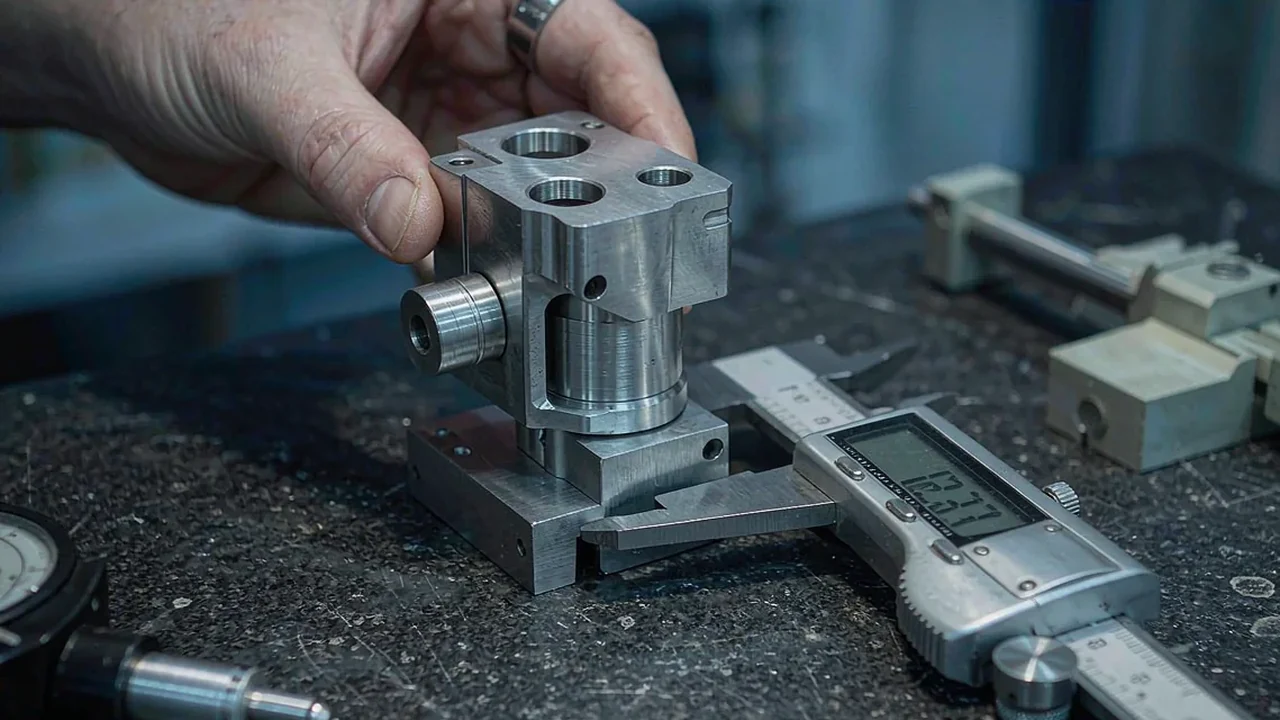
A finish is chosen for one of three reasons: corrosion protection, wear resistance, or appearance. Choosing it early matters because it affects dimensions, tolerances and how the part is handled during production.
As-machined
The cheapest and fastest option. Tool marks remain visible. Fine for internal parts, structural brackets and anything that will not be seen. Specify a surface roughness value if appearance or sealing matters.
Bead blasting
Produces a uniform matte texture and removes light tool marks. Common before anodising. It slightly rounds sharp edges, so it should not be applied to sealing faces or precision edges.
Anodising (aluminium)
An electrochemical layer grown into the aluminium surface. Clear anodising keeps a metallic look, colour anodising adds black, red, blue and other tones, and hard anodising builds a thicker, wear-resistant layer. The coating adds a small amount of thickness, which matters for tight-fitting bores and threads.
Plating and black oxide (steel)
Zinc plating gives sacrificial corrosion protection; nickel plating adds wear resistance and a brighter finish; black oxide gives a mild black finish with limited corrosion resistance and is often oiled. All add thickness, so threaded fits need to be planned.
Passivation (stainless steel)
A chemical treatment that removes free iron from the surface and improves corrosion resistance. It does not change dimensions noticeably and does not change appearance much.
Painting and powder coating
Paint allows any colour and is easy to repair; powder coating is more durable and more even but thicker. Both hide machining marks, both add thickness, and masking is required when some faces must stay bare metal.
Polishing
Mechanical polishing to a mirror finish is labour-intensive and is normally applied only to visible faces. It is also the finish most easily damaged in handling and packing.
Practical checks before specifying a finish
- Does the coating thickness affect any fit, thread or bore?
- Which faces must stay uncoated (grounding, sealing, pressing)?
- Will the part be handled roughly after finishing?
- Does colour need to match a RAL or Pantone reference, and on which faces?
- Is the finish needed on all sides or only on visible ones?
Summary: Finishing often costs more in handling than in the process itself. Finishing only the faces that need it is usually the single largest saving available on a cosmetic part.
Need parts made to your drawing?
Request a quote